
Plumber in Windward
Windward is one of Alpharetta's flagship master-planned communities from the 1980s-90s build wave. Slab-on-grade housing stock, polybutylene supply lines on many homes, aging copper on others, the classic Alpharetta plumbing fingerprint.
Windward developed in the late 1980s and 1990s as one of Alpharetta's flagship master-planned communities. The housing stock is overwhelmingly slab-on-grade with the original plumbing materials from that era, polybutylene on a big share of homes, copper on others. Now 30+ years in, all three of our top services run heavily here.
- Licensed & insured
- Local crew, Alpharetta-based
- 24/7 emergency dispatch
- Upfront pricing
The call we run most often in Windward
The dominant plumbing call we get from Windward is the slab leak. By a wide margin. Windward developed through the late 1980s and 1990s as one of Alpharetta's flagship master-planned communities, and the housing stock is overwhelmingly slab-on-grade with copper supply lines embedded in or running under the slab at install. Those copper lines are now 28 to 38 years old. This is the heart of the residential copper pinhole-leak window.
A typical Windward week sees us out for two to four slab leak diagnostic visits, plus the follow-up work those visits trigger: spot repair, line rerouting, or for homes with multiple developing leaks, the whole-home repipe conversation.
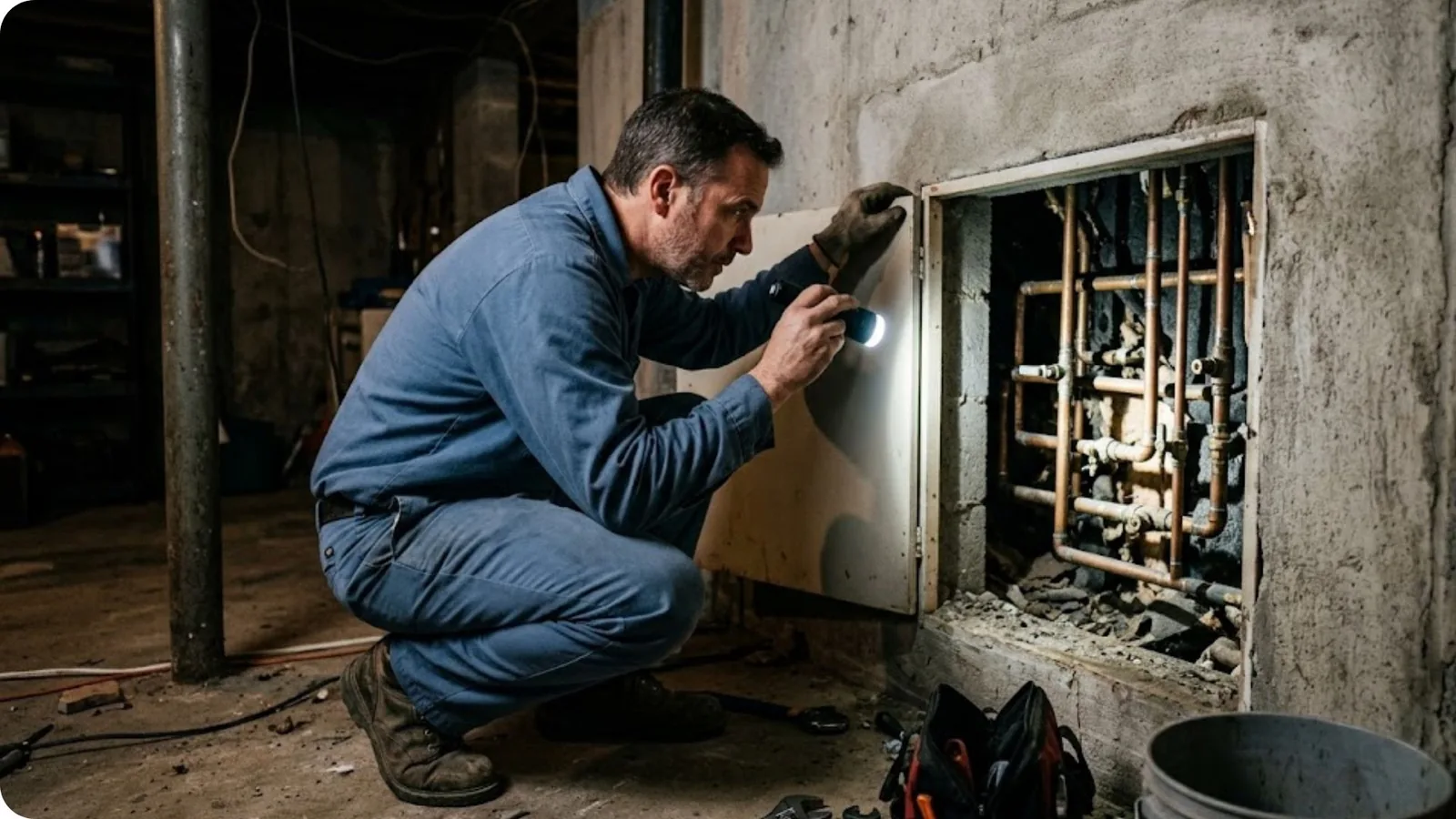
Why this shows up more here than average
Three reasons Windward sees this more often than newer Alpharetta subdivisions. First, the build era: 1985 to 1998 is the residential copper sweet spot for pinhole-leak development on chlorinated municipal water. Older homes usually have galvanized or earlier copper; newer homes have PEX. Windward sits in the middle.
Second, the slab-on-grade construction: copper supply lines embedded in slab can't be inspected without invasive access. Issues develop silently for months before producing symptoms.
Third, the water chemistry: the Atlanta-Fulton Water Treatment Plant in Johns Creek treats Chattahoochee source water to specs that prioritize bacteriological safety. The treatment profile is moderately aggressive toward older copper, accelerating the pinhole-development timeline that water chemistry produces nationally.

Catching it early vs. catching it late
Catching a Windward slab leak early vs. late: the cost difference is big. Early-catch (within weeks of the first symptom) is usually a spot repair or a line reroute, with localized floor restoration. Late-catch (months of unidentified leak) compounds water damage to flooring, drywall, and adjacent structures, and the project scope grows accordingly.
The three early symptoms we ask Windward homeowners to watch for: an unexplained water bill increase month over month, a warm spot on a tile floor that doesn't match anything that should be heating it, and the sound of running water with every fixture confirmed off. Two of three together is a strong signal. All three together is basically a confirmation. See our slab leak symptoms guide for the full diagnostic checklist.
When the early symptom isn't actually the problem
The diagnostic complication on Windward calls is that the three classic slab leak symptoms each have alternative explanations. A water bill spike could be a leaking toilet, an outdoor irrigation leak, or a stuck zone valve. A warm floor spot could be a heating duct running below tile rather than a hot-side slab leak. The sound of running water could be a water hammer issue, a partly-closed valve, or a refilling toilet.
The diagnostic visit rules each out systematically before opening any concrete. We don't quote a slab leak repair until acoustic, thermal, and electronic tracing each confirm the same location. False-positive slab leak diagnoses lead to unnecessary concrete demolition; we'd rather take an extra 30 minutes on diagnostics than create a problem that didn't exist.
Live dispatcher · 24/7 · Licensed & insured